

What, in essence, is the sublime? There must surely be some mechanism—visual, auditory, psychological, etc.—capable of bringing forth this sublime that I seek so intensely. This is what Baldine Saint Girons (1945) attempts to demonstrate in her book Le Sublime de l’Antiquité à nos jours (2025). Reading it requires sustained effort, given the density of the scholarship that runs through it. The book is 212 pages long, excluding the notes, divided into nine short and well-structured chapters. It lends itself to a fragmented reading, moving from one idea to another, provided one possesses a certain paideía. Here is what I took away from it.
Paideía
Longinus, an anonymous Greek writer of the first century, is probably the author of the first Treatise on the Sublime, although Plato had already addressed the question, emphasizing above all the necessity of possessing a paideía—which, broadly speaking, refers to a general education or cultivated knowledge, what the Romans would later call humanitas, those very humanities so strongly championed by the Renaissance and by Ontario’s classical colleges.
For Plato, if the sublime is in fact one of the fruits of paideía, it is because the sublime emerges from the tension between exotericism (knowledge accessible to everyone) and esotericism (knowledge reserved for the initiated), as in astrology, Kabbalah, or alchemy. These disciplines are certainly ancient, but today, faced with the dizzying expansion of knowledge, are we not, in a sense, initiates ourselves when it comes to Art and Aesthetics—and I deliberately capitalize both words?
In short, Saint Girons explains that, beyond a solid general education, one must also possess a profound knowledge of the discipline one has acquired.
A Paradoxical and Theatrical Experience
Moreover, tension becomes the leitmotif of the sublime, according to the Greek writer Longinus. In her introduction, Baldine Saint Girons explains that the sublime is first and foremost a “paradoxical experience,” characterized by internal tensions and contradictory feelings, “such as pleasure and displeasure, terror and enthusiasm, indifference and respect.” There is a poetic fusion of opposites. It is somewhat akin to the famous antinomies of life that Breton emphasized in his Second Manifesto of Surrealism. If the writings of Tolstoy or Shakespeare continue to hold us, it is in part because they bring to the fore such relationships as war and peace, life and death, love and hatred, etc. The same can be said of the immortals of painting, music, literature, and so forth. Chiaroscuro is a wonderful example: how can the light be dark?
Think, among others, of the works of Caravaggio—and what can one say here about that magnificent Saint Sebastian by Reni? There is something profoundly libidinal about the sublime: Eros draws us toward the object of our fascination, while Thanatos whispers that this fascination already contains the possibility of our disappearance. As in the great passions—from Les Liaisons dangereuses to Tristan and Isolde—desire thus becomes inseparable from danger, and pleasure from the transgression of our own limits.
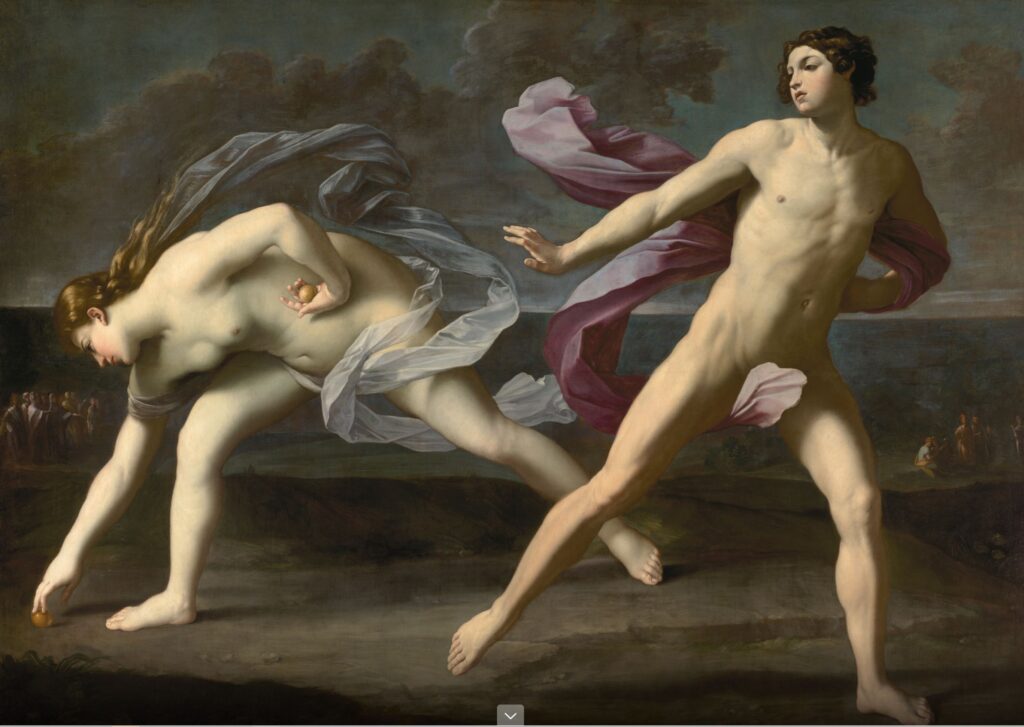
The sublime presents itself as a “theatrical manifestation” of the world, of life, “at once guilty and innocent, real and innocent.” There is also the fact that this sublime is fleeting: “the sublime presents itself as an apparition and withdraws at the very moment it seizes me […] it merely passes by.” But oh, how it passes! In its passing, Longinus writes, “the soul rises […] as if it were itself the creator of what it has heard” (p. 13). While looking at Reni’s sublime Hippomenes and Atalanta in Madrid (below), I found myself saying, “Wow, wow, wow!” And there it was: the sublime had manifested itself. And then, just as quickly, it disappeared the moment I began to analyze the technique. Then it reappeared with another “wow!” when I asked myself: “But how did he manage to paint this fleeting quality?” And, as if by enchantment, it disappeared once again.
It is the ungraspable within the graspable, much like what we encounter in Hippomenes and Atalanta itself.
Romanticism
Naturally, the chapter on Romantic sublime holds my attention, with its return of the soul, which “carries the lover, the melancholic, and the poet toward sublime, wild, and untouched nature” (p. 124). Here, the author invokes Schopenhauer to lead us into the underlying mechanisms through which the sublime manifests itself, particularly in Beethoven’s work. How does the composer produce his sublime? Through the juxtaposition of the pounding of the timpani with silence—once again, a contradiction on the one hand—and, on the other, through the “diminished fifth,” a dissonant harmonic interval—yet another contradiction—the equivalent of the “diabolus in musica, which expresses the collapse of time and the disappearance of possibilities” (p. 127). As for painting, she naturally turns to the works of Friedrich, Delacroix, Hugo, etc.—works that “arrive at the body,” simultaneously physical, imaginary, and sociocultural… reaching toward that something evermore about to be, as she quotes the English poet Wordsworth on page 134.
Spirituality
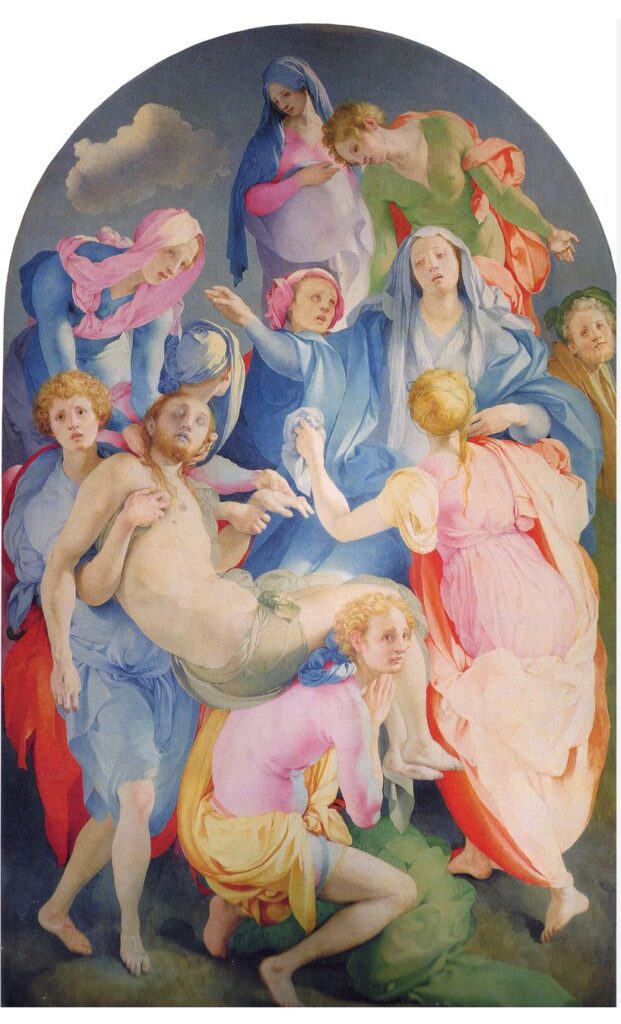
The strategy of “translating values into signifiers”¹—the beautiful, the good, the true—as well as transcendence, knowledge, and the search for things, accompanies us throughout the book, from Plato, of course, all the way to Deleuze (read post on Deleuze) I also discovered just how deeply the sublime is bound to spirituality, and particularly to the Christian tradition, where the inexpressible becomes the very place of faith: “What, in the experience of art, takes the place of faith?” (p. 86). Why do we return again and again to that little Florentine church to look once more at Pontormo’s fresco The Deposition from the Cross (above), even though the cross does not actually appear in the work? And yet we see the cross!
Could there be, behind this fascination, some secret connection between the taste for God and the taste for the sublime? This is one of the many questions raised by Baldine Saint Girons in this remarkable book. Would believing in the “God” of Einstein or Spinoza be enough—that is, not in a personal deity, but in a form of harmony immanent within the world?
The Capacity to See
Indeed—and rightly so—the author examines the relationship between the sublime and American Expressionist painting, particularly the work of Newman and Rothko, who evoke the sublime through the representation of “nothing” on something intensely physical—once again, a contradiction—rather like Pontormo’s invisible cross. Newman, together with Gottlieb, would state in an article published in the New York Times, quoted here by the author: “We assert that the subject is crucial and only a tragic and timeless subject is valid. The American sublime is a sublime of pioneers and carries no message: it is an annunciation without an announcement, the presentation of nothing, that is, of the thing itself” (p. 169).
Rothko insists on making the invisible visible, revealing the truth of our destiny, whether individual or collective. It is up to the viewer to have the capacity to see! To experience their own feelings! But to do so, one must be equipped for the twenty-first century—which brings us back to that famous paideía mentioned at the beginning.
Conclusion
I must bring this to a close, because I could go on and on. Yes, the book has won me over—but I need to read it again. For Baldine Saint Girons, the sublime finds its essence in the manifestation of opposites—in that tension between terms that, logically, ought to exclude one another (light-dark). This is why she describes it as an oxymoron, “a mysterious figure” (p. 10). And there it is again!—as illustrated by the image of the jumbo shrimp: how can a shrimp be jumbo?
This tension finds a privileged place in the religious history of the West: for two thousand years, the sublime has manifested itself through the presence of the divine. Must we therefore conclude that belief is a necessary condition for the sublime? I will leave the question open. Perhaps what matters is not faith itself, but rather our capacity to confront something greater than ourselves—transcendence.
1) A “translation into signifiers. I love it! It had to be done! ” Meaning "image-making "
0 Comments