

(Above, Guido Reni, Hippomenes and Atalanta, Prado, Madrid, Spain.Here an episode of Métamorphoses d’Ovide (Book X, verses 560–707) please Google.)
Finding the sublime
Warning
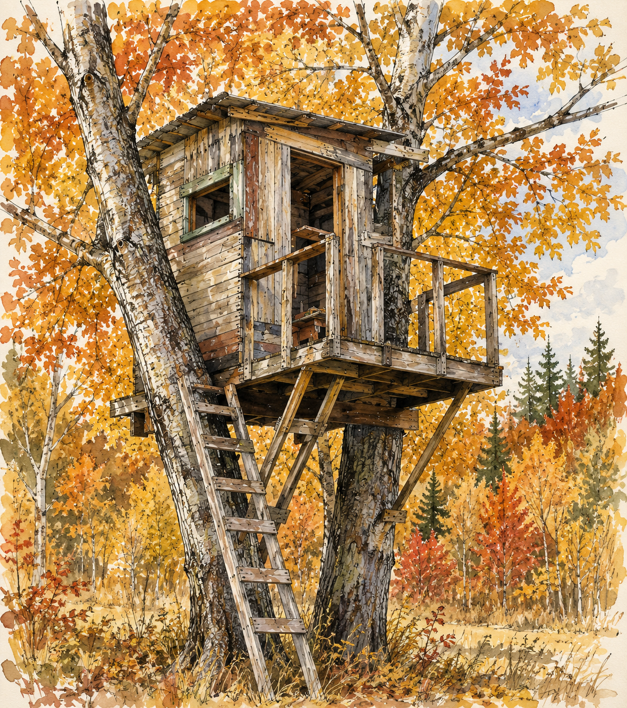
This text is poorly constructed, somewhat like the treehouse of my childhood. A treehouse perched ten feet above the ground between two trees, which back then seemed to me to be forty feet tall, built from scraps of plywood, pieces of 2 x 4s, discarded boards, assorted nails from the garage, and old ropes from the shed. To my brother and me, that treehouse was sublime—especially after school, with our cookies, and after our favourite TV show Bobino, of course.
Let’s Climb
“I” have just returned from Italy and Spain, and I am completely “museumed out!” I have seen too much: from the Uffizi Gallery in Florence to the Reina Sofía in Madrid, with two Picasso museums, countless architectural marvels, and contemporary art galleries along the way. My neurons can’t take it anymore; they simply can’t make any more connections. I’ve seen everything: from ancient art to contemporary art and… “the best of the best.”
All this to say that, as time goes by, the notion of the sublime in a work of art is becoming increasingly important to me. And here, I mean the sublime itself, not the “sublime-ish”—that which we merely think is sublime.
Looking back, I sometimes wonder: did I give up professional painting seriously in 2005 because I thought that I would never be able to reach the sublime? (Yes, I still paint today.) Did I abandon painting to devote myself fully to teaching the best art classes in the world, hoping that I might at least pass on this quest for the sublime to others?
Yes!
A choice had to be made: either devote my days to pursuing the “ungraspable,” or pay my mortgage to the bank that will not hesitate to “grasp” our house—which, unlike the sublime, was never in any hurry to elude me.
Oh, how the sublime slips away from those who no longer have the leisure to pursue it.
A Few 2 x 4s for Support
First, I need to define this sublime so that I can grasp it. What is it?
How can I reach it as a visual artist? How can I bring onto the canvas that part of my soul that is so dear to me, without ever betraying my honesty, and without worrying about the gaze of others?
How could my painting move someone as deeply as Guido Reni’s Hippomenes and Atalanta, which I saw at the Prado, moved me? How could my music touch souls the way the music of Albinoni and Chopin does?
I want it, I want it, I want it!
There must be some kind of mechanism—a visual, auditory, psychological mechanism—that allows this famous sublime to appear.
Where do I nail my 2 x 4s?
And then, in one of the museum shops, I come across Baldine Saint Girons’s (1945) book, Le Sublime de l’Antiquité à nos jours (2025).
Finally! I tell myself.
I need to know!
Plywood Scraps for the Floor
Let us return to the museums. The fourth floor of the Reina Sofía confirmed what I liked least about visual art: the judgmental, doctrinaire flavor of 1970s conceptual art, somewhat reminiscent of the moralizing art of today—not to say woke art. Even morality itself has now become aesthetic, writes Yves Michaud in L’Art est bien fini (2025).
I am thinking here of Kosuth and his text Art after Philosophy (1969), which adopts an almost prescriptive tone about what art ought to be. For the hard-core conceptualists, there is a distrust of sensory pleasure, technical virtuosity, and emotion—an austerity reminiscent of a form of moral asceticism. They would proclaim: “this is art, this is not”; “painting is dead”; “the idea takes precedence over execution”; “you don’t see what is happening”; and so on.
This fourth floor was nothing more than a succession of rooms saturated with photographic images, projections of demonstrations, and videos of naked bodies—all traces of unrestrained nationalism or a religion running out of breath.
Wo!, Wo!, Wo!, … I know perfectly well that art has always been permeated by politics and religion. I also recognize that conceptual art represented a necessary detour: it established a dialogue between artists, institutions, and audiences. If conceptual art seeks to clarify an idea—sometimes to the point of making a moral judgment about what art ought to be—the sublime, by contrast, precisely refuses such sharp distinctions. It remains in ambiguity, in the oxymoron, in the indefinable.
In this sense, judgmental conceptual art would be almost the antithesis of the sublime as Saint Girons describes it.
The Rusted Sheets of the Roof
As I wandered once again through the galleries of these seemingly indestructible museums and revisited those eternally small churches, why did I still find myself stopping before a Guido Reni, before Goya’s dark visions at the Prado, before a Rothko at Palazzo Strozzi, or before Pontormo’s unforgettable Deposition at Santa Felicità?
And then… and then… and then…
No, no, no!
It is too much beauty, too much truth, too much soul.
Is my neural system simply wired this way? Is it what condemns me to being moved by certain works, as though they were speaking to a part of me older than my own memory?
Why am I willing to look again and again at a Tom Thomson, a Lawren P. Harris, a Caravaggio, a Van Gogh, but not at a work by M. Abramović, J. Kosuth, or J. Dibbets?
Why do I never tire of the song Un Canadien errant? (A Wondering Canadian)
I want to see, and I want to make, a painting that theorizes the world, that adds soul to nature. I want an experience that engages my entire being: beyond thinking, I want above all to feel—and to make others feel. I am a sentient being.
The sublime responds to a “universal of imagination, not of reason,” writes Baldine Saint Girons.
Making an idea crystal clear, as conceptual art does, is one thing; knowing how to shape that idea so that it touches the imagination, as Italian Mannerist painting does—or, closer to our own time, the work of Alex Colville, Andrew Wyeth, or Odd Nerdrum—is quite another.
From the Top of My Treehouse
Fortunately, since returning to Canada, with its vast spaces and its nature, my country offers me its share of the sublime every day. It is like climbing onto the roof of my childhood treehouse to sit quietly and watch the squirrels and birds.
Has the time finally come to paint this sublime? If so, I will have to do it with precision—with equal attention to the image and to the technique.
0 Comments